

Explore the Unknown with Accredited Artificial Intelligence Courses
Discover accredited courses from the world of Artificial Intelligence to upgrade and excel today.
Pluralsight
Learn and explore AI with a community of learners today
Udacity
Kickstart your software development career with certified nano degrees
Udemy
Improve your conversational skills in 30 days with native speakers
Artificial Intelligence (AI) is revolutionizing industries and creating numerous career opportunities. As businesses and organizations increasingly rely on AI technologies, the demand for skilled professionals in this field is on the rise.
This article explores the various career options in AI and the basic skill requirements, as well as addresses frequently asked questions about online software development courses.
Career Options in Artificial Intelligence
Machine Learning Engineer: Develops algorithms and models that enable machines to learn and make decisions.
Data Scientist: Analyzes complex data to extract insights and inform business decisions using AI tools.
AI Research Scientist: Conducts advanced research to develop new AI technologies and methodologies.
AI Software Developer: Designs and builds AI applications, integrating AI capabilities into software products.
Robotics Engineer: Develops and program robots to perform tasks autonomously or with human assistance.
Natural Language Processing (NLP) Engineer: Focuses on enabling machines to understand and respond to human language.
Computer Vision Engineer: Specializes in enabling machines to interpret and make decisions based on visual data.
AI Product Manager: Oversees the development and implementation of AI-driven products and solutions.
Business Intelligence Developer: Utilizes AI to enhance data analysis and reporting for business decision-making.
AI Consultant: Provides expert advice to organizations on integrating and optimizing AI technologies.
Find Out More Here →
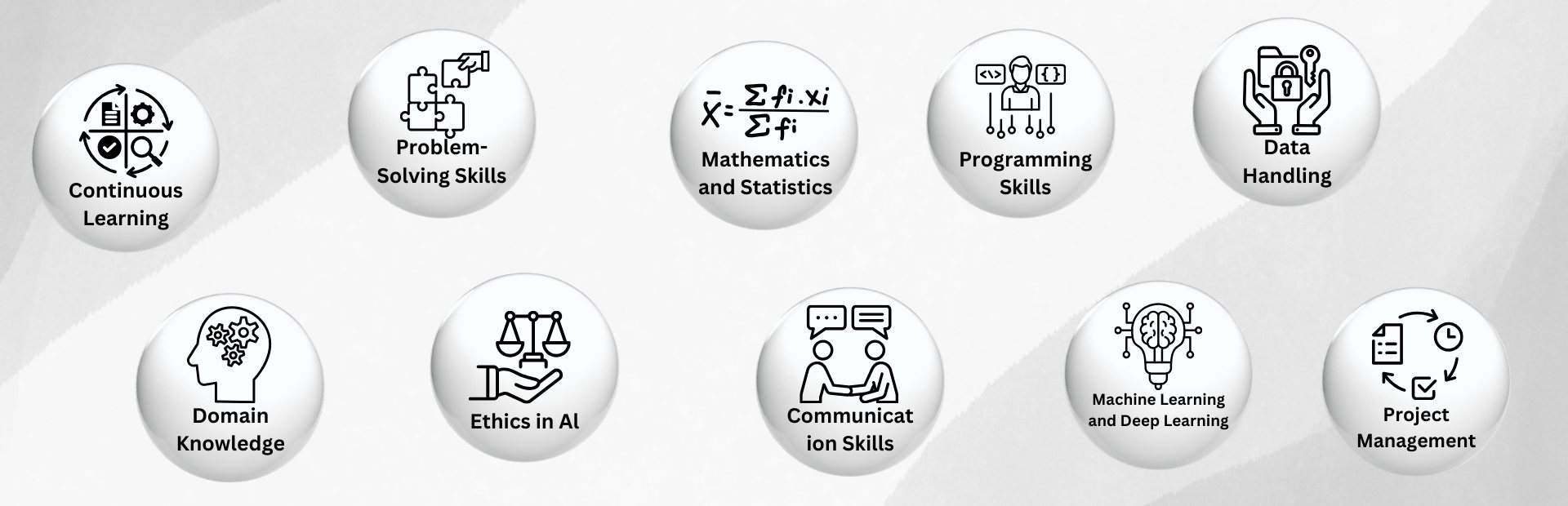
Basic Skill Requirements for a Career in AI
-
Programming Skills: Proficiency in languages such as Python, R, Java, and C++ is essential for developing AI models and algorithms.
-
Mathematics and Statistics: A strong foundation in linear algebra, calculus, probability, and statistics is crucial for understanding AI concepts.
-
Data Handling: Skills in data preprocessing, cleaning, and visualization are important for working with large datasets.
-
Machine Learning and Deep Learning: Knowledge of machine learning algorithms, neural networks, and deep learning frameworks like TensorFlow and PyTorch.
-
Problem-Solving Skills: The ability to approach complex problems methodically and develop effective solutions.
-
Domain Knowledge: Understanding the specific industry or application domain where AI will be implemented.
-
Communication Skills: Effective communication is necessary to explain AI concepts and solutions to non-technical stakeholders.
-
Continuous Learning: AI is a rapidly evolving field, so staying updated with the latest research, tools, and technologies is essential.
-
Project Management: Skills in planning, executing, and managing AI projects are valuable for leading teams and meeting project goals.
-
Ethics in AI: Understanding ethical considerations and ensuring the responsible use of AI technologies.
Where to Learn from? Top Platforms
Although there are tons of great platforms available out there, we have done the homework for you to offer best from the rest. Here is our top three picks for you in learning Artificial Intelligence.
Learn More About This →
Conclusion
Pursuing a career in artificial intelligence offers exciting opportunities across various industries. With the right skills and knowledge, you can position yourself at the forefront of this rapidly evolving field. Online software development courses provide a flexible and accessible way to acquire the necessary skills, making it easier for aspiring AI professionals to achieve their career goals.

Frequently Asked Questions
What are the best online platforms for software development courses?
Popular platforms include Udemy, Coursera, Udacity, edX, Pluralsight, and Codecademy.
Can beginners take online software development courses?
Yes, many courses are designed for beginners and provide a solid foundation in software development.
What programming languages should I learn first?
Python, JavaScript, and Java are commonly recommended for beginners.
How long do online software development courses take?
Course durations vary from a few weeks to several months, depending on the depth and complexity of the subject matter.
Are there free online courses for software development?
Yes, platforms like Khan Academy, Coursera, and edX offer free courses, though some may require payment for certificates.
Do online courses provide certificates?
Many online courses offer certificates upon completion, which can be added to your resume or LinkedIn profile.
Can I get job placement assistance after completing an online course?
Some platforms, like Udacity and Coursera, offer career services and job placement assistance.
What are the prerequisites for taking advanced software development courses?
Prerequisites may include basic programming knowledge, familiarity with data structures, and understanding of algorithms.
How do I choose the right software development course for my career goals?
Consider your current skill level, career objectives, course content, and reviews from other learners.
Are online software development courses recognized by employers?
Many employers recognize and value online course certificates, especially when combined with a strong portfolio of projects.
Our Best Pick



Read More