
Speak the Bavarian Way: Top 5 Platforms to Learn German

Speak the Bavarian Way: Top 5 Platforms to Learn German

Speak the Bavarian Way: Top 5 Platforms to Learn German

  • Join a pool of 15 million global learners
  • Experience 20+ different dialects and accents
  • Become one of the 200 million global German speakers
  • Learn from over 5 million words

Learn German with interactive methods and exercises.

Lingoda

750k course per year for every learner

Babbel

Discounted award-winning language courses

Italki

Interactive visual learning methods for every need

  • Start learning at $8.45/mo*
  • 10-minute learning sessions
  • Learn conversational Spanish in 20 days
  • Research built learning curated by 200+ experts

(5/5)

See More Info

Why Do We Recommend it?

15+ years of language teaching
More than 47.4 million app downloads globally
SSL certified encryption available
All language access gifting options available

  • Verified community tutors at just $5/hour
  • 1:1 and group sessions available
  • Join free community to learn and practice anywhere
  • Interactive methods like podcasts, quiz for learning

(5/5)

See More Info

Why Do We Recommend it?

10 million+ happy learners over globally
149+ languages to learn from.
Engaging revision with different prompts and quiz.
Multiple resources and challenges for effective learning

  • Start learning at just $10.50 /class
  • 7-day free trial available
  • Personalized feedback for faster learning
  • Best for learning conversational Spanish

(5/5)

See More Info

Why Do We Recommend it?

Choose from different packages for different learning needs
Placement test available for beginners for
5 other languages available for learning
Learn about culture and explore tradition

  • 30-day money back guarantee
  • Start learning at just $15.99/mo*
  • School and enterprise learning solutions
  • Speech recognition to improve pronunciation

(5/5)

See More Info

Why Do We Recommend it?

20+ other languages available
Immersive learning for lasting results
Offers specialized training for learners
Dedicated blog and newsroom for updates

  • Start learning at just $3 /per session*
  • Best for 1:1 learning sessions
  • Advanced filters to pick out best tutors
  • Communicate with tutors before booking a class

(5/5)

See More Info

Why Do We Recommend it?

40,000+ tutors for 50 different languages
Demos available for corporate training
Intense verification process to ensure session credibility
Language training for employee relocation available

The German Comparison: Lingoda, Babbel, italki, Rosetta Stone, and Preply

Learning the German language requires not only time and commitment but also choosing the right learning platform. In today’s market, there are many online platforms that facilitate learning German. In this article, we compare five popular platforms: Lingoda, Babbel, italki, Rosetta Stone, and Preply. We consider factors such as pricing, accreditation, duration, instructors, industry ratings, and user experience to help you choose the best option for your needs.

Pricing/Preise

Babbel is the most cost-effective option, with monthly subscriptions starting at just €5.

Duration/Dauer

Lingoda offers flexible course durations, from intensive daily sessions to more relaxed weekly classes.

Instructors/Lehrer

Lingoda employs qualified, native-speaking teachers with a rigorous vetting process.

Accreditation/Akkreditierung

Lingoda provides accredited courses with official CEFR certificates, making it the top choice for learners seeking formal recognition.

User Experience/Benutzererfahrung

Babbel is known for its user-friendly interface, making it an excellent choice for beginners and those who prefer a straightforward learning experience.

Industry Ratings/Industriebewertungen

Lingoda has a strong industry reputation, particularly for its structured and intensive programs.

The End: Which Platform is the Best?

Lingoda emerges as the overall winner in this comparison. It excels in most categories, particularly in accreditation, instructor quality, and course flexibility. This makes Lingoda the best choice for learners seeking a professional and structured approach to learning German, especially those who value accredited certification.

Babbel is a strong contender, especially for budget-conscious learners who prefer a self-paced learning experience. Its user-friendly platform and cost-effectiveness make it the best choice for beginners or casual learners.

Italki and Preply are ideal for those who prioritize flexibility and personalized instruction. These platforms are best suited for learners who want direct interaction with native speakers and customized lesson plans.

Rosetta Stone remains a solid option for those who prefer an immersive, self-guided learning experience and value a long-standing reputation in the industry.

Ultimately, your choice will depend on your specific needs, budget, and learning style, but Lingoda stands out as the top recommendation for most learners

Curious to know why the German language has three genders? Start learning today.

How to Choose a Language Learning Platform?

At Top10foryou, our team of experts has conducted extensive research on various platforms. We understand your needs and have prepared a list of the best platforms to guide you in making the right decision.

Our method is designed to provide you with a reliable learning path backed by our deep understanding of your needs.

Pricing: We’ve evaluated prices in our review process, ensuring we recommend the most cost-effective platforms.

Accreditation: We’ve conducted thorough research on every platform’s certifications and partnerships to ensure credibility and integrity.

Course Duration: We have closely examined the average duration to help you understand their learning flexibility.

Instructors: We have verified the instructor’s profile to make your work easy.

Platform Library: We dived deep into the content and course library to learn how many courses they offer.

Flexibility: We analyze the platform’s features, course structures, and user feedback to ensure that the platform suits learners of all levels and types.

Industry Grade Rating: Brand reputation is analyzed via credible third-party platforms, online reviews, and our editors to make sure that the platform provides value for money.

User Experience: We carefully evaluate the platform, its accessibility, support, and refund policies to ensure a seamless user experience.

Frequently Asked Questions

How long does it take to learn German?

The time it takes to learn German depends on various factors, such as your native language, the amount of time you dedicate to learning, and your learning method. On average, reaching a conversational level might take about 600-750 hours of study.

What is the best way to learn German?

A combination of methods, including attending classes, using language apps, practicing with native speakers, and immersing yourself in German media (books, films, music), is often the most effective approach.

Is German difficult to learn?

German can be challenging due to its grammar rules and pronunciation. However, with consistent practice and dedication, it is manageable. English speakers may find some similarities with German vocabulary.

Do I need to learn German grammar?

Yes, understanding German grammar is essential for constructing correct sentences and improving communication. Focus on key aspects like articles, cases, and verb conjugations.

Can I learn German online?

Absolutely! Many online resources, such as apps, websites, and virtual classes, offer flexible learning opportunities. These platforms often include interactive exercises and access to native speakers.

How can I improve my German pronunciation?

Listening to native speakers, practicing speaking regularly, and using language apps with pronunciation feedback can help improve your pronunciation. Mimicking sounds and practicing tongue twisters can also be beneficial.

Is it necessary to learn German vocabulary extensively?

Building a strong vocabulary is important for effective communication. Start with everyday words and phrases, then gradually expand your vocabulary based on your interests and needs.

Are there dialects in the German language?

Yes, there are many dialects in German, such as Bavarian, Swabian, and Saxon. Standard German (Hochdeutsch) is used in formal settings, and learning it will help you understand and communicate across different regions.

What resources can help me practice German listening skills?

Podcasts, audiobooks, German TV shows, and movies are excellent resources for improving listening skills. Try listening to content with subtitles to aid comprehension initially.

How important is cultural immersion in learning German?

Cultural immersion can significantly enhance your language learning. It helps you understand context, idiomatic expressions, and cultural nuances, making your communication more effective and authentic.

Our Best Pick

Why Learn a Programming Language Like Python? Find the Perfect Answer For Your Curiosity

Why Learn a Programming Language Like Python? Find the Perfect Answer For Your Curiosity

Why Learn a Programming Language Like Python? Find the Perfect Answer For Your Curiosity

Explore programming languages for professional upskilling.

Coursera

Learn programming languages with hands on projects

Udacity

Kickstart your software development career with certified nano degrees

Udemy

Improve your conversational skills in 30 days with native speakers

You are reading this article because recently, some words have been roaming your mind, like Programming language, Coding, Python, Java, C++, and many more. You are searching for answers to these questions, such as ‘What is Programming Language? ‘ and’ What is Python? ‘ Is there any career opportunity in programming? What will you get as a salary package?’ and many more these are just some of them.

Fortunately, you landed on the right page, and we will tell you everything you are looking for. In short, top10foryou will answer your questions with this article related to ‘Programming Languages like Python, JavaScript, C++, R and SQL.’ All you have to do is just be with us till the end, and we will help you choose the right online learning platform for mastering coding skills.


Decoding the World of Programming Languages

Language is the basic element in the communication process. It allows you to transfer your views on something to someone else. Similarly, in the world of computers, Programming Language is a way for the programmer to communicate his or her instructions to the computer.

Programming Languages are the set of rules and instructions that are generated in the code to tell the computer what to do.

To make it simpler for you, it’s like asking Google for a route map. When you instruct Google to show directions for a specific place, the instructions work as the programming language, and the directions are the actions Google takes. Programming languages are classified into two different categories:-

1- High-Level Language

2- Low-Level Language

Let’s understand both in detail.


Explore Programming Language courses today:-


What is High-Level Language?

High-level languages are closer to humans and easily understandable. They include terms like order and run, symbols, letters, and phrases that represent clear instructions and are easy for humans to understand. Basically, they focus on what the computer needs to do instead of how to do it.

The following are the advantages offered by High-level language to programmers:-

  • It hides the complex details of a computer, which can make the programmer’s work more difficult.

  • Moreover, programs designed with this language can be easily run on different computers without making any changes, which means programmers can use single code on various devices without any difficulty.

  • It contains clear commands and helpful tools which makes the coding and testing work easier for the programmer.

  • It is best for managing memory, as programmers do not need to allocate or free up memory manually.

  • Finding and fixing mistakes with High-level language is easy.

  • It includes some pre-written codes, which allow you to focus on your major work and eliminate the need to start from scratch. This leads to high productivity.

Examples of High-Level Languages

Here is a list of the most common and highly popular languages of this particular category:-

1- Python- It is easy to understand as it contains simple syntax.

2- Java- It is not as easy as Python, but known for its use on multiple platforms.

3- C++ – It is suitable for making complex software and is widely used.

4- Ruby- It has elegant syntax and remarkable frameworks.

5- JavaScript- It is used with HTML, and its library helps to create multipurpose web applications.


Where Can You Use It?

You can use a high-level language in Web Development, Data Analysis, DBMS, and Game Development.

  • Web Development- HTML, CSS, and JavaScript

  • Data Analysis- R and Python

  • DBMS- PHP and SQL

  • Game Development- C++


What is Low-Level Language?

Low-level Language is more closely related to hardware than software, which offers little or no abstraction from machine instructions. It allows programmers to manipulate hardware elements according to requirements. It is commonly used for designing systems such as operating systems, device drivers, and embedded systems. These languages are further divided into two parts: Machine Language and Assembly Language.

The following are the advantages offered by the Low-Level language to programmers:-

  • It helps to write highly optimized codes easily which offers efficiency to programmers.

  • They are able to manipulate hardware registers and memory locations.

  • It enables precise control over device peripherals to change codes for specific tasks.

  • They can easily implement security features.

Examples of Low-Level Languages

Here is a list of the most common and trendy languages Low-Level language:-

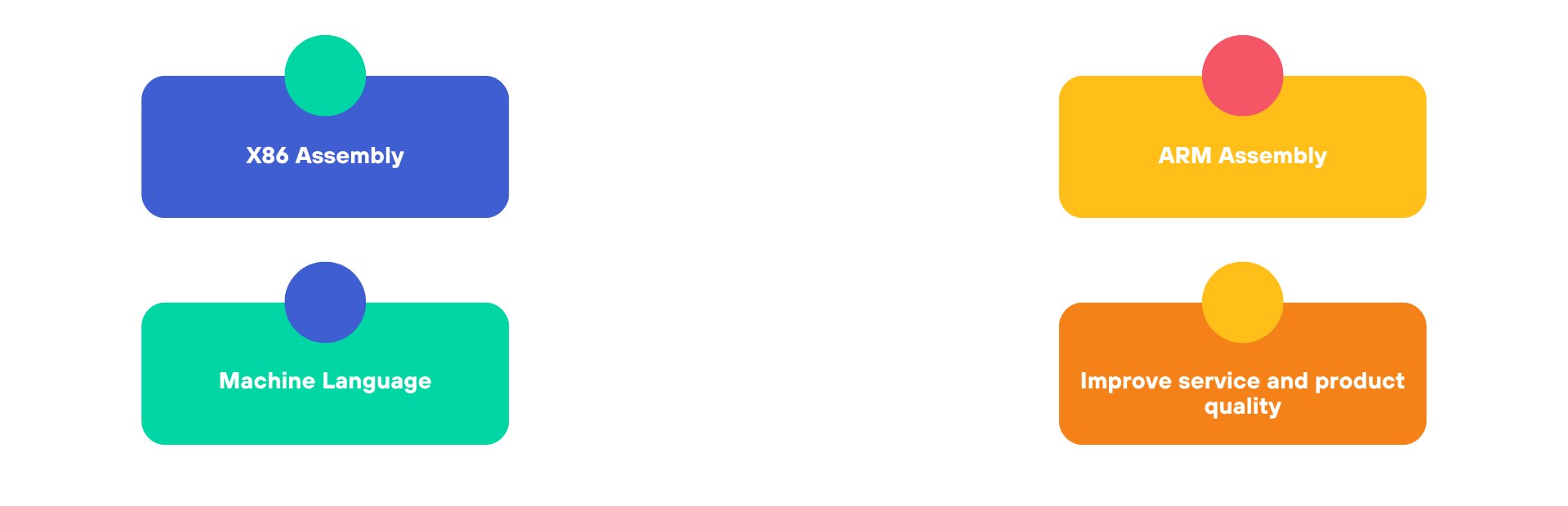
1-X86 Assembly- It is commonly used in Intel-based systems.

2-ARM Assembly- It is widely used in embedded systems, mobile devices, and IoT applications.

3-Machine Language- It offers binary code that the CPU can execute directly.


Where Can You Use It?

Low-level language can be used for the coding of the following programs:-

  • Operating System Development

  • Embedded Systems

  • Device Drivers

  • Real-Time Systems

  • Reverse Engineering

Learn More:-


What are the Types of Programming Languages?

Once you know the difference between high-level and low-level classification of programming languages, it’s time to tell you the types of programming languages. There are commonly five types of programming languages:-

1- Procedural Programming Language: It follows a series of commands or statements to get the desired output. Examples include C, C++, Java, Pascal, and BASIC.

2- Functional Programming Language: It works opposite to procedural language. It focuses on the output of mathematical functions and evaluations. For example, Scala, Erlang, Haskell, Elixir, and F#

3- Object-oriented programming Language (OOP): It treats a program as a group of objects composed of data and program elements. Examples include Java, Python, PHP, C++, and Ruby.

4- Scripting Language: It automates repetitive tasks and manages dynamic web content. Examples include PHP, Ruby, Python, Bash, Perl, and Node.js.

5-Logic Programming Languages: It help computers make decisions by instructing them through a series of facts and rules. Examples include Prolog, Abscess, Datalog, and Alma-0.


What are the Career Paths for You?

If this information excites you to learn more about it and you want to pursue a career, then look at what career opportunities you have with expected salary packages.

1- Cloud Engineer- National average salary: $100,290 per year

2- Computer programmer- National average salary: $72,923 per year

3- Computer software engineer- National average salary: $79,366 per year

4- Database administrator- National average salary: $79,407 per year

5- Deep learning engineer- National average salary: $78,209 per year

6- Java Developer- National average salary: $93,382 per year

7- iOS developer- National average salary: $98,346 per year

8- Mobile application developer- National average salary: $87,552 per year

9- Programmer analyst- National average salary: $72,276 per year

10- Robotics engineer- National average salary: $76,821 per year

Where Should You Learn From?

After extensive research, we have selected some of the best platforms for Programming Language courses. These three platforms focus on specific learner needs, cater to individual goals, and meet everyone’s expectations.

Final Takeaway

Ultimately, you know everything about programming languages, from what it is to where you can learn them online with expert guidance and the best curriculum. It’s time to get started with the top platforms offering the best courses in learning programming languages and be a master in coding skills.

So, don’t waste your time anymore. Choose the perfect programming language course for you that perfectly suits your learning style, needs, and pocket.

Frequently Asked Questions

What are the best online platforms to learn programming?

Some of the best platforms include Coursera, Udemy, edX, Codecademy, Khan Academy, and freeCodeCamp.

Are online programming courses practical?

Yes, online programming courses can be highly effective, especially when they offer interactive coding exercises, projects, and instructor feedback.

Do I need any prior experience to start learning programming online?

No prior experience is required. Many courses are designed for beginners and provide step-by-step instructions.

What programming language should I start with?

Popular beginner-friendly languages include Python, JavaScript, and Ruby. Python is often recommended due to its simplicity and wide range of applications.

How much time will it take to learn programming?

The time required varies depending on the complexity of the language and the learner’s dedication. On average, it may take a few months to grasp the basics and several more to become proficient.

Can I get a job after completing an online programming course?

Many online courses provide certificates and have partnerships with tech companies, which can help with job placement. However, building a portfolio of projects and gaining practical experience is also crucial.

Are there free resources available for learning programming?

Yes, there are numerous free resources available, such as freeCodeCamp, Khan Academy, and some courses on Coursera and edX.

How important is it to do projects while learning?

Projects are very important as they help you apply what you’ve learned and build a portfolio that can be shown to potential employers.

Do online programming courses offer support and community?

Many platforms offer forums, community support, and mentorship. Engaging with these resources can greatly enhance your learning experience.

Can I learn programming on my own, or do I need a mentor?

While many people successfully learn programming on their own, having a mentor can provide guidance, answer questions, and help you stay motivated.

Our Best Pick

Top 3 Online Platforms to Learn English Effortlessly

Top 3 Online Platforms to Learn English Effortlessly

Top 3 Online Platforms to Learn English Effortlessly

  • Start learning English at great discounts online
  • Personalised interactive learning methods
  • Native speaking english teachers for cultural understanding
  • Become conversational fluent in just 30 days

Top 3 online platforms for easy and effective English learning.

British Council

Choose your perfect teacher from over 200 tutors to learn English effectively

Coursera

Experience affordable English language learning with great discounts

Udemy

Improve your conversational skills in 30 days with native speakers

  • 650 million learners
  • Spanning 200 countries
  • IELTS Preparation
  • Prepare for your foreign plans with IELTS preparation.

(5/5)

  • 7000+ world-class Courses
  • Partnered with 275+ leading Universities

(5/5)

  • Trusted by 15000 Companies
  • AI-powered coding Exercises
  • 75K+ instructors and 220K+ courses

(5/5)

Best Practices for Learning English Language

1. Relationship Building: This one is a “no-brainer” no matter what language you speak. As a teacher, getting to know each student helps you understand who they are, where they come from and, perhaps, gain some insight into what teaching and learning styles are most effective for them.

2. Cultural Awareness: Since many English language learners come from outside the U.S., part of creating the ideal learning atmosphere may include cultivating an appreciation of diversity. Developing an awareness of each student’s background, religious and cultural practices may also provide insights that affect how you interact with a particular student (for example, if they come from a cultural tradition where eye contact with adults is viewed as disrespectful).

3. Language Skills for Curriculum Topics: In many cases, your English language learners may also be receiving specific English as a Second Language instruction from an ESL specialist. However, it is helpful for teachers of all curriculum topics in mainstream classrooms to understand and embrace the role of language teacher as well.

4. Patience: You have a lot of material to cover, but there is no need to rush. In fact, teachers of ELLs are encouraged to consciously slow things down. The extra seconds give all students a little extra time to think and formulate a response.

5. The Engaging Learning Methodology: The idea here is to provide students with multiple options for taking in information, processing and making sense of ideas, and sharing what they are learning. This is often referred to as “differentiated instruction” — an educational practice that involves recognizing that “students each have their own unique gifts and challenges; interests, aptitudes and learning styles” and tailoring instruction to meet students’ individual needs.

6. Enhance your Vocabulary: When you have a challenging reading assignment coming up, some experts encourage you to preview or “pre-teach” new vocabulary words that may be unfamiliar to ELLs, or even to give them a copy of the article or link to the material ahead of time.

How to Choose a Language Learning Platform?

At Top10foryou, our team of experts has conducted extensive research on various platforms. We understand your needs and have prepared a list of the best platforms to guide you in making the right decision.

Pricing: We’ve evaluated prices in our review process, ensuring we recommend the most cost-effective platforms.

Accreditation: We’ve conducted thorough research on every platform’s certifications and partnerships to ensure credibility and integrity.

Course Duration: We have closely examined the average duration to help you understand their learning flexibility.

Instructors: We have verified the instructor’s profile to make your work easy.

Platform Library: We dived deep into the content and course library to learn how many courses they offer.

Flexibility: We analyze the platform’s features, course structures, and user feedback to ensure that the platform suits learners of all levels and types.

Industry Grade Rating: Brand reputation is analyzed via credible third party platforms, online reviews, and our editors to make sure that the platform provides value for money.

User Experience: We carefully evaluate the platform, its accessibility, support, and refund policies to ensure a seamless user experience.

Frequently Asked Questions

What is the origin of the English language?

English originated from the Anglo-Frisian dialects brought to Britain by Germanic settlers. It has evolved significantly over time, influenced by Latin, Norse, and French, among other languages.

What are the different varieties of English?

English has several varieties, including British English, American English, Canadian English, Australian English, and Indian English. Each has its own unique pronunciation, vocabulary, and grammar rules.

Why is English considered a global language?

English is widely used in international business, diplomacy, science, and technology. Its global reach is due to historical factors like the British Empire and the economic influence of the United States.

What are the basic components of English grammar?

English grammar consists of parts of speech (nouns, verbs, adjectives, etc.), sentence structure, tenses, punctuation, and syntax. Mastery of these elements is essential for effective communication.

How can I improve my English vocabulary?

You can improve your vocabulary by reading widely, using flashcards, playing word games, and engaging in conversations with native speakers. Learning new words in context helps retain them better.

What are common challenges in learning English?

Learners often struggle with pronunciation, irregular verbs, phrasal verbs, and idiomatic expressions. Differences in spelling and pronunciation between American and British English can also be confusing.

How important is pronunciation in learning English?

Pronunciation is crucial for clear communication. Mispronunciations can lead to misunderstandings. Practice with native speakers, use pronunciation guides, and listen to English media to improve.

What are the best resources for learning English?

Effective resources include online courses, language apps, podcasts, English books, movies with subtitles, and language exchange communities. Consistent practice with diverse materials helps build proficiency.

How can I practice English speaking skills?

Practice speaking with native speakers, join conversation clubs, use language exchange platforms, and engage in role-playing exercises. Recording yourself and listening to the playback can also help improve your skills.

How do English proficiency tests work?

English proficiency tests, such as TOEFL, IELTS, and Cambridge exams, assess reading, writing, listening, and speaking skills. They are used for academic admissions, job qualifications, and immigration purposes.

Our Best Pick

Learn Business English Effortlessly Today

Learn Business English Effortlessly Today

Learn Business English Effortlessly Today

Exploring top platforms to learn business english seamlessly

British Council

Choose your perfect teacher from over 200 tutors to learn English effectively

Rosetta Stone

Explore accents and learning activities at great discounts

Preply

Find the perfect tutor for you to practice and learn business english

Language learning isn’t just cool, but can also help you excel in the professional world every day by helping you state precise statements and arguments day in and day out. For instance, let us take English, the unofficial global language. Everyone in the professional world knows and speaks the language for most part, but business english is an entirely different ball game.

But the catch with business english is finding the right platform to learn it from. In case you are looking to find places to learn business english from, we have you covered. Read this article and follow along to learn about business english and the career opportunities that can follow.

But before you start learning, how exactly does business english offer a professional head start?


Learn More About This:-


Perks of Learning Business English

1. Higher Chances of Employment: One of the most employable traits in employees for international and English-speaking companies worldwide, a good grasp of business English is vital for any international professional, with studies showing that poor English communication skills can hamper the attempts of finding a good job.

Showing up to an interview with a great grasp of business English makes a great first impression. And also sets you apart from the competition. Employers do judge a book by its cover. So studying business English can be a massive help in making that great first impression. And also engaging in conversations about the company and job role itself.

As well as appearing knowledgeable and enthusiastic about what you do, it also means that where possible. You’ll sound more eloquent and professional when talking about your work. In many competitive international industries, job applicants are likely to have this skill under their belt, so to boost your own employability you should too!

2. Excel Among Peers: As English is the dominant business language worldwide, communication and trade worldwide, English communication skills in the workplace are beneficial for numerous reasons. Learning the correct business English improves your general workplace communication. And also makes life easier on a day-to-day basis. As it ensures you are able to hold a conversation with your boss or superiors without sounding too formal or informal.

Business English classes teach you keywords and phrases that will assist you when in many areas. For example, meetings, catching up with colleagues, and socializing in English-speaking business environments!

If you can’t communicate effectively with the people you are working with, key professional relationships are likely to suffer. So you should consider learning business-English to boost your general communication skills too.

3. Rise Above Cultural Barriers: Not only does learning business English allow you to communicate better with English-native colleagues, clients, and employers. But it also provides you with the skills to communicate with other non-native speakers, and break down any cultural barriers that could create a toxic environment in your workplace.

In 2021, it is vital that businesses are doing everything they can to break down these social and cultural barriers. Especially in leading international businesses whose systematic regulations have a knock-on effect to those of all the smaller businesses working with them.

If you’re an employer we recommend offering company wide non-native staff business English training. For the benefit of both your staff and your company.

If you’re an employee why not approach your employer on the subject and see if they would be happy to fund your training. After all, it will benefit them too!

4. Hone your Written Communication: With written communication being vitally important to business in the digital age, there are many written communication skills you will need to work in any international or English speaking workplace. These include being able to effectively and professionally:

  • Write Business Emails.
  • Write Detailed Business Reports.
  • Create Important Documents.
  • Create Clear Presentations & Pitches.
  • Write Letters to Clients & International Business Partners.

Learning business English will provide you with the foundation to progress in all of these skills and much more. Ensuring both your written communication and general communication in the workplace are on top form. We highly recommend learning business English if you want to boost your English professional writing skills, especially in competitive industries.

5. Improved Workplace Results: One of the key benefits of learning business English is that it can give you a competitive advantage in the business world. It will help you understand the language that is used every day by clients and competitors alike. Giving you that much more insight into their mindsets and allowing you to target them with a better understanding. This is sure to lead to better results.

Also, if your communication in the workplace is smooth and clear, your results are going to benefit. Whether you’re attending an international business meeting or negotiating with a new client, misunderstandings and confusion can only be detrimental to the success of your endeavors. If your vocabulary is on point and you understand all aspects of the conversation, chances are much higher that you’ll come out on top and see an improvement in your results.

6. Experience a New World: There are a lot of perks that stretch beyond the square space of your office or the professional world.

It can offer you new and exciting opportunities that you might otherwise have missed out on. This could mean moving up the professional ladder quicker than expected. Or even broadening your horizons into a new industry if you’re willing to learn. Learning business English is truly a core skill that can recreate your life and open you up to a world of possibilities.

Where to Learn From? Top Platforms

Although there are tons of platforms available to learn business english, we have conducted an in-depth research to offer some of the best names in the business that can help you learn the language seamlessly.

Read the full Article 

Conclusion

Business English can not only help you in the professional world but can also help you broaden your horizon for better opportunities that are waiting in the outside world. Honing your english speaking skills can certainly help you climb the professional ladder quickly to achieve great success.

Frequently Asked Questions

What is Business English?

Business English refers to the type of English used in business contexts, such as international trade, finance, and corporate communications. It focuses on vocabulary, phrases, and practices specific to the business world.

Why is learning Business English important?

Learning Business English is important because it enhances communication skills in professional settings, improves career opportunities, facilitates networking, and helps in understanding global business practices.

What are the best ways to learn Business English?

The best ways to learn Business English include enrolling in courses (online or offline), using language learning apps, reading business publications, practicing with a language partner, and engaging in business-related conversations and activities.

Are there any recommended online courses for Business English?

Yes, several reputable platforms offer Business English courses, including Coursera, Udemy, LinkedIn Learning, and EF English Live.

What topics are covered in Business English courses?

Topics typically include business vocabulary, email writing, report writing, presentation skills, negotiations, meetings, telephone etiquette, and intercultural communication.

Are there specific textbooks or materials for learning Business English?

Yes, popular textbooks include “Market Leader,” “Business Result,” and “English for Business Studies.” Additionally, many courses provide their own materials.

How can I practice Business English in my daily life?

You can practice by reading business news, writing emails and reports, participating in business meetings or discussions, joining professional networks, and attending industry conferences or webinars.

Can learning Business English help with job interviews?

Absolutely. Business English skills can help you communicate more effectively in job interviews, understand industry-specific terminology, and demonstrate professionalism and competence.

Are there certifications for Business English proficiency?

Yes, some recognized certifications include the Cambridge BEC (Business English Certificates), TOEIC (Test of English for International Communication), and BULATS (Business Language Testing Service).

How long does it take to become proficient in Business English?

The time required varies depending on your current level of English, the intensity of study, and practice. Generally, it can take several months to a few years to achieve proficiency.

Our Best Pick

Comparing the Top 10 Platforms for Learning Business English

Comparing the Top 10 Platforms for Learning Business English

Comparing the Top 10 Platforms for Learning Business English

Exploring the top-ranked platforms for learning business English

British Council

Choose your perfect teacher from over 200 tutors to learn English effectively

Rosetta Stone

Explore accents and learning activities at great discounts

Preply

Find the perfect tutor for you to practice and learn business english

  • 650 million learners
  • Spanning 200 countries
  • IELTS Preparation

(5/5)

  • 25 languages
  • 24/7 tutoring sessions.
  • Best for employees to enhance speaking skills.

(5/5)

  • 7000+ world-class Courses
  • Partnered with 275+ leading Universities

(5/5)

  • Trusted by 15000 Companies
  • AI-powered coding Exercises
  • 75K+ instructors and 220K+ courses

(5/5)

  • 50 languages
  • 1-o-1 and group classes
  • Advanced learning tool

(5/5)

  • Instant session booking options
  • Learn with assessments, podcasts, and articles
  • Rewards for a great performance in assessments

(5/5)

  • 4000+ courses
  • 260+ leading institutions
  • Founded by Harvard and MIT

(5/5)

  • 2 Million classes per year
  • 59 years of teaching experience
  • 1:1 and live classes

(5/5)

  • Choose from 600 lessons
  • MP3 & Video Lessons
  • Take a Free Trial

(5/5)

  • 4 classes at just $0.99
  • 30-minute online classes
  • IELTS, TOEFL or TOEIC

(5/5)

In case you want to learn more about business english and why it can be a great option for your professional and personal growth, read this article.

How Did We Choose a Language Learning Platform for You?

Pricing: We’ve evaluated prices in our review process, ensuring we recommend the most cost-effective platforms.

Accreditation: We’ve conducted thorough research on every platform’s certifications and partnerships to ensure credibility and integrity.

Course Duration: We have closely examined the average duration to help you understand their learning flexibility.

Instructors: We have verified the instructor’s profile to make your work easy.

Platform Library: We dived deep into the content and course library to learn how many courses they offer.

Flexibility: We analyze the platform’s features, course structures, and user feedback to ensure that the platform suits learners of all levels and types.

Industry Grade Rating: Brand reputation is analysed via credible third party platforms, online reviews, and our editors to make sure that the platform provides value for money.

User Experience: We carefully evaluate the platform, its accessibility, support, and refund policies to ensure a seamless user experience.

Frequently Asked Questions

What is Business English?

Business English is a specialized area of English language learning focused on vocabulary, communication skills, and practices relevant to business contexts.

Why is Business English important?

It helps professionals communicate effectively in international business settings, enhancing job performance, career opportunities, and collaboration with global partners.

Who should learn Business English?

Professionals, students, and anyone working or aspiring to work in business environments where English is the primary language of communication.

What are the key areas of focus in Business English?

Key areas include business vocabulary, email writing, report writing, presentations, negotiations, meetings, and telephone communication.

How can I improve my Business English skills?

Practice regularly by reading business articles, listening to podcasts, engaging in conversation with native speakers, and taking specialized courses.

Are there online resources for learning Business English?

Yes, there are many online courses, apps, and websites that offer Business English lessons, such as Coursera, LinkedIn Learning, and BBC Learning English.

How long does it take to become proficient in Business English?

The time it takes varies based on your current level, the intensity of study, and exposure to the language. Consistent practice can lead to significant improvement in a few months.

What are some common Business English vocabulary terms?

Terms like ROI (Return on Investment), KPI (Key Performance Indicator), stakeholder, merger, acquisition, and market share are commonly used in business settings.

How is Business English different from General English?

Business English focuses more on industry-specific language and practical communication skills used in business contexts, whereas General English covers broader language skills.

Can I learn Business English on my own?

Yes, self-study is possible with the right resources, but combining it with interactive practice and feedback can enhance learning outcomes.

Our Best Pick